
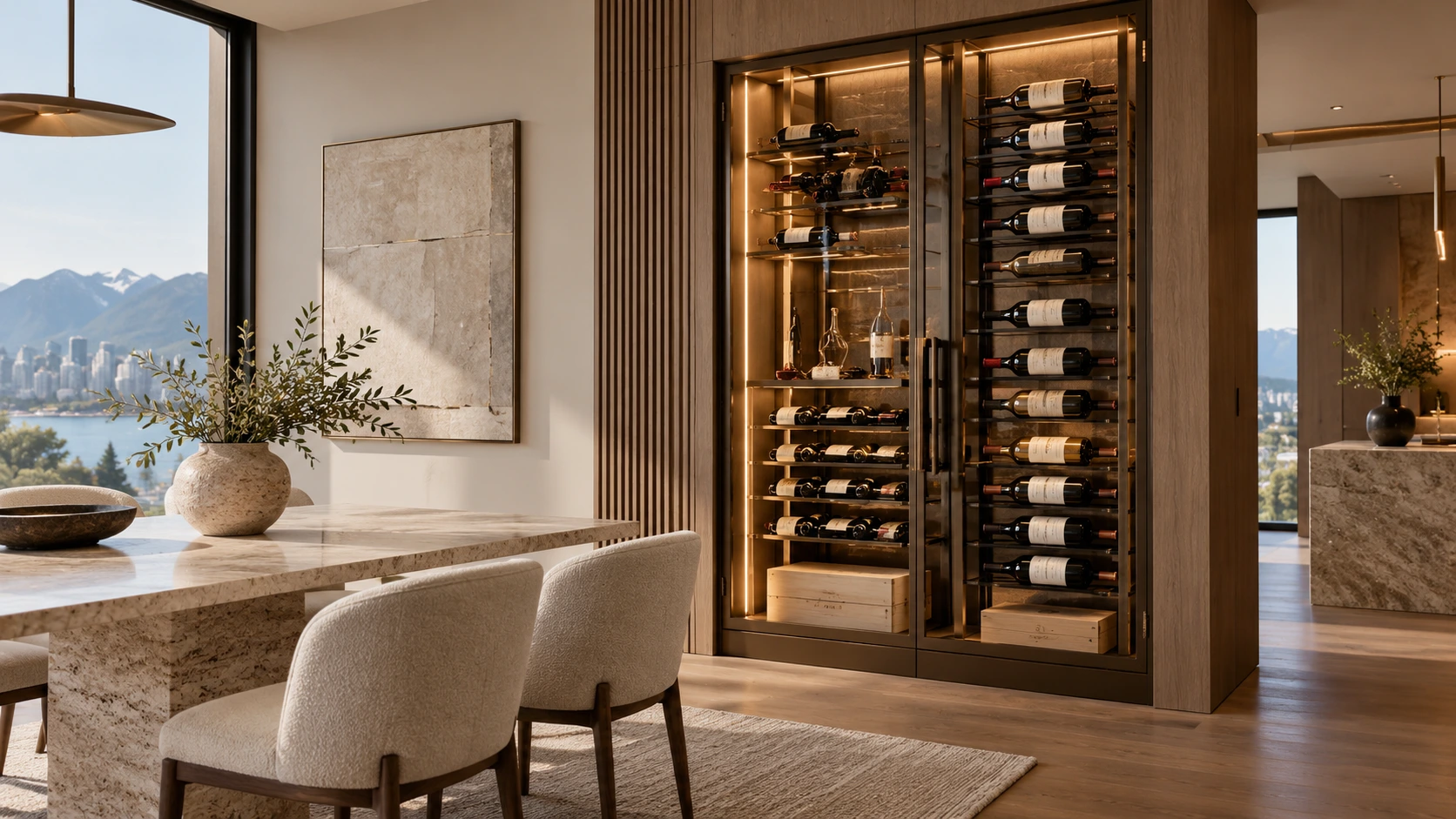
A home wine cellar does not necessarily require a large basement or a dedicated room. Depending on the size of your collection, the available floor space, and how you want to display your bottles, wine storage can be incorporated into surprisingly compact areas of a home.
For homeowners planning a wine cellar, the more useful question is not simply how large the room should be. It is how much space the collection needs today, how it may grow, and whether the chosen location can provide suitable storage conditions.
From compact wall displays to dedicated wine rooms, understanding these factors early can help you make better use of your space and avoid expensive design changes later.
How Much Space Does a Home Wine Cellar Actually Need?
There is no universal minimum size for a home wine cellar. The space required depends on bottle capacity, storage configuration, accessibility, and whether the installation is intended primarily for display or long-term preservation.
A small collection may fit comfortably within a narrow wall installation, while a larger collection may benefit from a dedicated, climate-controlled room.
As an initial planning reference, consider the following examples:
| Wine Collection Size | Potential Storage Approach |
|---|---|
| 20 to 50 bottles | Compact wall-mounted display or small cabinet |
| 50 to 150 bottles | Dedicated wall system, alcove, or larger cabinet |
| 150 to 300 bottles | Multi-wall storage or a compact wine room |
| 300 to 500 bottles | Dedicated storage area with carefully planned access |
| 500+ bottles | Larger wine room or custom-designed cellar |
These are illustrative capacity ranges, not fixed room-size requirements. Actual storage density varies considerably with bottle dimensions, rack design, display orientation, and the amount of clearance required.
A display that presents each bottle label outward will generally need more wall area than a high-density system storing bottles with their necks facing outward.
Before deciding on room dimensions, it is worth establishing how you want the collection to function.
Start With Your Bottle Collection, Not Your Floor Plan
One of the most common planning mistakes is designing storage around the number of bottles currently owned without considering future purchases.
For example, a homeowner with 80 bottles may initially plan for a 100-bottle installation. If they regularly purchase cases, collect wines for ageing, or entertain frequently, that capacity could become restrictive sooner than expected.
Consider three questions before choosing a layout.
How Many Bottles Do You Own?
Begin with an accurate count of your existing collection. Include bottles stored in kitchen cabinets, refrigerators, temporary racks, and other locations.
It is also useful to identify oversized bottles, such as Champagne bottles or magnums, because they may not fit standard storage openings.
How Quickly Is Your Collection Growing?
Think about your purchasing habits over the next several years.
Someone who buys wine primarily for immediate consumption may need relatively little additional capacity. A collector purchasing cases for long-term ageing will likely require more room.
Allowing some expansion capacity can reduce the need to redesign the installation later.
Do You Want Storage, Display, or Both?
A practical storage system prioritizes capacity and convenient bottle access.
A display-oriented installation may incorporate wider spacing, angled bottles, lighting, and architectural details that make the collection part of the interior design.
Many homeowners want a combination of both. Understanding that balance will help determine the most suitable use of the available space.
Can You Build a Wine Cellar in a Small Space?
Yes. A smaller home does not automatically rule out dedicated wine storage.
Several areas that might otherwise remain underused can accommodate a thoughtfully planned installation.
Under-Stair Spaces
The area beneath a staircase can offer an interesting opportunity for a compact wine display.
Its sloping ceiling, however, makes accurate measurements especially important. Rack depth, access, lighting, and the shape of the available wall all influence the final capacity.
If the space is enclosed, ventilation and environmental conditions also need to be considered.
Dining Room Walls
A dining room wine display can keep bottles accessible while adding a distinctive architectural feature.
Wall-mounted systems are particularly useful when homeowners want to preserve floor space.
For example, the transparent acrylic designs in the Ice Collection can provide inspiration for contemporary displays where visual openness is important.
Hallway Alcoves
A recessed wall or unused alcove may accommodate bottle storage without requiring an entire room.
The main considerations are sufficient depth, safe circulation space, and protection from excessive heat or direct sunlight.
Basement Corners
Basements are often considered for wine storage because some offer relatively stable temperatures compared with upper floors.
However, a basement is not automatically suitable for long-term wine preservation. Temperature fluctuations, moisture, ventilation, and insulation should still be assessed.
A compact basement installation can work well when the available conditions and storage requirements are properly considered.
How Much Depth Do Wine Racks Need?
Rack depth is one of the most important measurements when planning a wine storage area.
A standard 750 mL wine bottle is often approximately 30 to 33 centimetres long, although dimensions vary by bottle style.
This means the installation must account for more than the nominal bottle length.
Depending on the rack system, additional space may be required for mounting hardware, bottle orientation, structural support, and safe access.
For preliminary planning, homeowners should consider:
- The dimensions of the largest bottles they intend to store
- Whether bottles will be positioned horizontally, angled, or label-forward
- The depth of the selected rack or cabinet
- Clearance for removing bottles comfortably
- Any doors, glazing, or surrounding cabinetry
Always use the specifications of the selected storage system rather than relying on a single generic depth measurement.
This is particularly important for installations in narrow hallways or shallow wall recesses.
Choosing Between Wall-Mounted Storage and a Dedicated Wine Room
Both approaches can be effective, but they serve different purposes.
Wall-Mounted Wine Storage
Wall-mounted storage can be a practical choice for homeowners with limited floor space.
It may work particularly well in dining rooms, entertainment areas, or open-plan interiors where the collection is intended to remain visible.
Depending on the design, wall systems can also create a lighter appearance than full-depth cabinetry.
For homeowners considering a contemporary metal display, the Forge Collection offers examples of modern wine rack designs.
Dedicated Wine Rooms
A dedicated room provides greater flexibility for combining high-density storage, display shelving, and environmental control.
It may also be preferable for larger collections or wines intended for extended ageing.
However, room dimensions must account for comfortable movement, door clearance, shelving access, and any cooling or mechanical equipment.
A wine room that looks spacious on a floor plan may feel restrictive once full-depth storage is installed along multiple walls.
For that reason, usable interior space matters more than the room’s total square footage alone.
Don’t Overlook Temperature and Humidity
Finding enough physical space is only one part of planning a home wine cellar.
Storage conditions matter, especially for bottles intended to age over several years.
Wine is generally best stored in a cool environment with limited temperature fluctuation, away from direct sunlight and excessive vibration.
For many wines intended for long-term storage, temperatures around 12 to 14°C are commonly used as a planning reference. The appropriate conditions can vary depending on the wine, storage duration, and overall environment.
Humidity also deserves attention. Excessively dry conditions may affect natural corks over time, while excessive moisture can encourage mould and damage labels or surrounding materials.
A decorative wine display in a regularly heated living space is therefore not necessarily equivalent to a climate-controlled cellar.
For homeowners in Vancouver and the surrounding region, seasonal indoor heating, summer temperatures, and local moisture conditions are worth considering during the planning stage.
If long-term preservation is the priority, the suitability of the proposed space should be evaluated before finalizing the design.
How Does Rack Material Affect the Space?
The material and configuration of a wine storage system can influence both its appearance and the way it uses available space.
Wood Wine Racks
Wooden systems can create a warm, traditional atmosphere and may integrate naturally with existing cabinetry or architectural finishes.
They are often suitable for homeowners who prefer a more established, furniture-like appearance.
The Timber Collection includes wood-based wine storage designs that can help homeowners explore this approach.
Metal Wine Racks
Metal systems can support contemporary designs with clean lines and visually lighter structures.
Depending on the product, they may be used for wall-mounted storage or architectural bottle displays.
Acrylic Wine Displays
Clear acrylic can create a more open visual effect, allowing bottles to become the focus of the installation.
This can be particularly appealing in smaller rooms where heavy-looking cabinetry might make the space feel crowded.
Traditional Custom Cabinetry
For homeowners seeking integrated cabinetry, traditional shelving, or a more substantial built-in appearance, the Legacy Collection illustrates a different design direction.
The best material is not necessarily the one that holds the most bottles. It is the one that supports the intended capacity, available space, access requirements, and overall design.
How Much Walking Space Should You Leave?
A dedicated wine room needs enough clearance for people to enter, move around, and retrieve bottles safely.
As a preliminary planning consideration, a clear aisle of approximately 90 centimetres may provide a useful starting point for comfortable access in some residential layouts.
However, this is not a universal building-code requirement or a guaranteed suitable dimension.
The actual clearance should reflect the room’s configuration, door movement, shelving depth, accessibility needs, and applicable building requirements.
For example, placing storage on two opposing walls reduces the central aisle.
A room measuring two metres across may appear adequate when empty, but full-depth shelving on both sides can significantly reduce the usable walking area.
Before construction, it is helpful to test the layout using the actual dimensions of the proposed storage systems.
Should You Plan for Future Expansion?
For many homeowners, the answer is yes.
Wine collections often change over time. A storage system designed precisely around today’s inventory may become less useful as purchasing habits evolve.
Future expansion does not always require building a larger room.
It may involve reserving part of a wall for additional racks, selecting a modular configuration where appropriate, or allocating separate areas for everyday bottles and long-term storage.
The important point is to consider growth before the installation is complete.
Retrofitting additional storage can be more complicated when lighting, cabinetry, glazing, or cooling equipment has already been installed.
A Practical Checklist Before Planning Your Wine Cellar
Before selecting a wine storage design, take time to document the following:
- Current bottle count: Include all bottles you intend to move into the new installation.
- Future capacity: Estimate how the collection may grow over the next few years.
- Bottle dimensions: Identify Champagne bottles, magnums, and other non-standard formats.
- Available measurements: Record wall width, height, depth, ceiling shape, and obstructions.
- Access requirements: Consider doors, walkways, and how frequently bottles will be retrieved.
- Storage purpose: Decide whether the priority is display, everyday access, long-term ageing, or a combination.
- Environmental conditions: Review temperature, humidity, sunlight, and ventilation.
- Design preferences: Consider whether wood, metal, acrylic, or traditional cabinetry best suits the interior.
Having this information ready makes it easier to compare possible layouts and identify limitations before committing to a design.
Planning a Home Wine Cellar in Vancouver
Homes across Vancouver and the Lower Mainland vary considerably in layout, from compact condominiums to larger detached properties.
A successful wine storage installation should respond to the actual dimensions and conditions of the home rather than follow a standard room template.
For some homeowners, a compact wall display may be the most practical solution. Others may have sufficient space for a dedicated cellar with custom shelving and controlled storage conditions.
Timeless Wine Cellars offers a range of wine storage design directions through its Collections, including acrylic, wood, metal, and traditional configurations.
Exploring these options can help you understand how different systems might work within your available space.
Final Thoughts
The amount of space you need for a home wine cellar depends less on a particular room size and more on how you intend to store, access, and grow your collection.
A small, carefully planned installation may serve a modest collection extremely well, while a larger wine room requires thoughtful consideration of shelving depth, circulation, environmental conditions, and future capacity.
Start by measuring your available space and understanding your bottle storage needs. From there, you can evaluate the layout and materials that make the most sense for your home.
If you are considering a wine storage project, explore the available designs at Timeless Wine Cellars and discuss which approach may suit your space and collection.
